
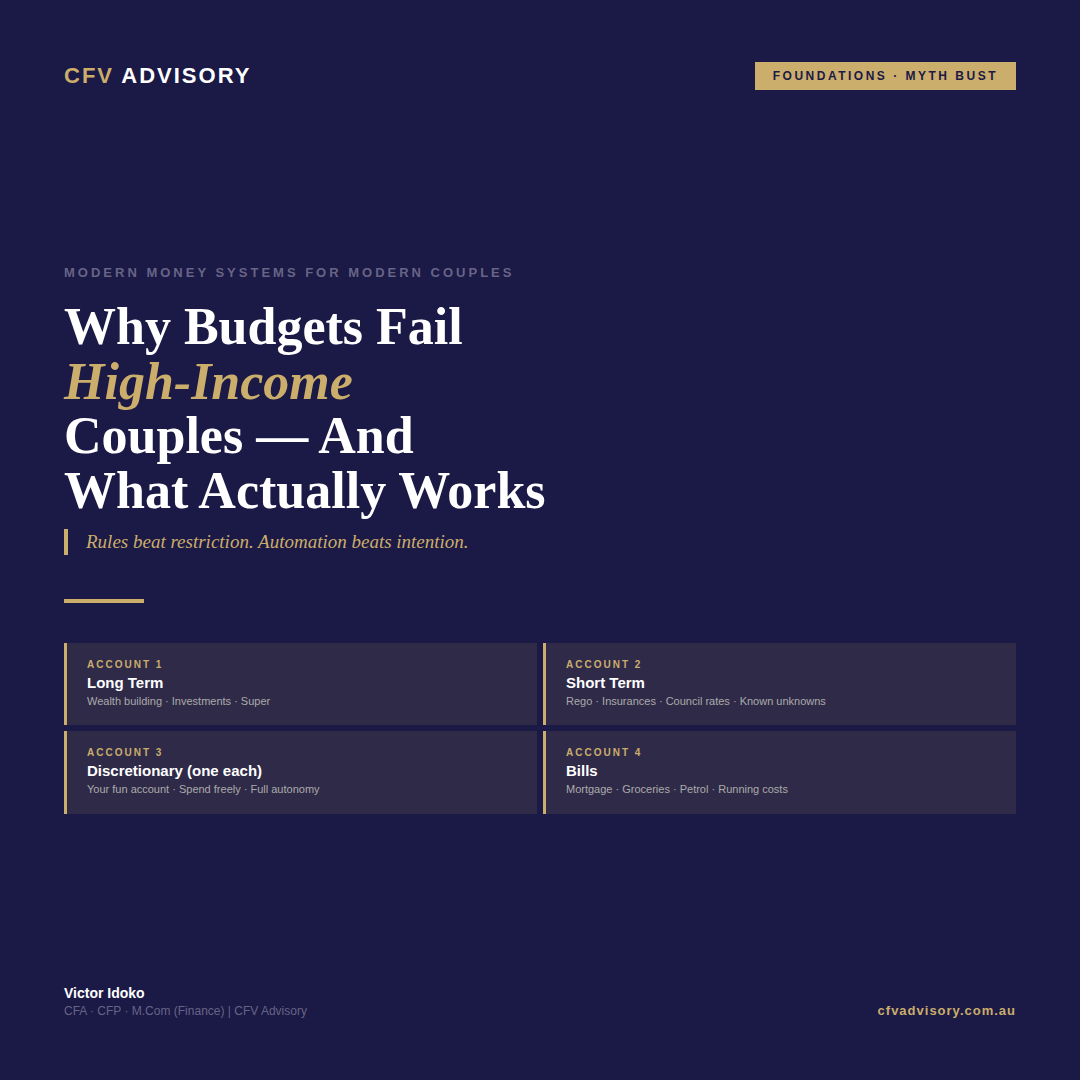
If you’re still managing money like it’s 2005 — a shared spreadsheet, a weekly budget review, maybe a jar labelled “holidays” — there’s a reason it feels exhausting. That system was designed for a world where one person worked, incomes were simpler, and financial products were limited. Your household is completely different. It’s time your money system was too — because Why Budgets Fail High-Income Couples often comes down to relying on systems that were never built for how they actually earn and live.
Budgets fail high-income couples for a specific, structural reason: they treat financial management as an activity rather than an architecture. You schedule time to review the budget, sit down together to reconcile categories, and feel guilty when something goes over. And then — because life is genuinely full and demanding — you eventually stop doing it entirely.
The solution isn’t more discipline. Furthermore, it isn’t a better app, a fancier spreadsheet, or a shared family finance meeting on Sunday evenings. The solution is a system that works without you — one that routes money correctly by default, builds wealth automatically, and only needs your attention four times a year.
“Rules beat restriction. Automation beats intention. The households building real wealth aren’t monitoring their spending more carefully — they’ve built a system that makes monitoring unnecessary.”
What This Article Covers
The 4-account automation system that replaces budgeting for dual-income households earning $200K–$400K
❶ WHY BUDGETS FAIL HERE
The structural mismatch between budgeting tools and dual-income realities
❷ THE 4-ACCOUNT FRAMEWORK
Long Term · Short Term · Discretionary · Bills — plus an emergency fund
❸ PAYDAY AUTOMATION
Every account is funded automatically — the day after pay arrives
❹ THE QUARTERLY REVIEW
Four 90-minute sessions per year replace 52 weekly budget reviews
Section 01
Why Budgets Fail Specifically for High-Income Couples
Let’s be precise about this. Budgets don’t fail for everyone. For a household on $75,000 managing a genuine cash constraint, a detailed expense budget is the right tool. Every dollar needs a destination because there aren’t enough of them to be casual about it.
However, for a dual-income couple earning $280,000, the problem isn’t scarcity — it’s direction. The cash is there. The issue is that it flows out to lifestyle commitments faster than it flows into wealth-building assets. A budget that tracks the first category doesn’t help with the second. As a result, you end up monitoring symptoms while the actual disease — structural financial drift — goes unaddressed.
There are also three practical realities that make traditional budgeting particularly unsuitable for dual-income professional couples:
Consequently, the budget isn’t just hard to maintain — it’s actively misleading. It gives a false sense of control over the wrong variables while the real wealth-building levers go untouched. To understand what those levers look like, our piece on the four leaks quietly draining dual-income families goes deeper.
Section 02
The 4-Account System That Actually Works
The most effective modern money framework for dual-income couples isn’t a budget — it’s an account architecture. Rather than tracking what you spend, you structure where money lands before decisions are made. Each account has a single, defined purpose. Money flows into every account automatically — the day after payday. And what happens inside each account is entirely yours to manage without guilt or a spreadsheet.
Here’s how the four accounts work — plus the emergency fund that sits beneath all of them as the foundation.
Account 1
Long Term Account
Wealth building · Investments · Super contributions
This is the engine of your financial future — and it gets funded first. The day after payday, an automatic transfer moves a fixed amount here before you’ve made a single spending decision. For most $280K households, this should represent at least 20% of take-home pay.
Wealth building outside super covers your mortgage offset account and investment platform contributions. The offset account is particularly powerful — every dollar sitting there reduces the non-deductible interest on your home loan daily, effectively earning a guaranteed after-tax return equal to your mortgage rate.
Super contributions — your salary sacrifice runs through payroll before either income hits the bank, so it never touches this account. However, any additional voluntary contributions or catch-up concessional contributions flow from here. The concessional contributions cap sits at $30,000 per person per year — and most high earners are significantly under it, leaving meaningful tax savings on the table.
Account 2
Short Term Account
Rego · Insurance renewals · Council rates · Known unknowns
This account solves one of the most common reasons budgets collapse: irregular but predictable expenses that arrive quarterly, bi-annually, or annually. Car registration. Home and contents insurance. Council rates. Private health insurance renewal. Strata levies. Each of these is entirely foreseeable — yet when several arrive in the same month, they feel like a financial emergency because no system was designed to absorb them.
Additionally, this account holds a provision for known unknowns — costs you know will eventually arrive, just not exactly when. The hot water system that needs replacing. The fridge that gives out. The car service that finds a problem. These aren’t emergencies — they’re the normal cost of running a household. Treating them as surprises is what drives budget-busting behaviour.
A weekly automatic transfer into this account — sized to your actual annual periodic costs divided by 52, plus a known-unknown buffer — means these bills are always pre-funded. Christmas doesn’t blow the month. The fridge gets replaced without a second thought.
Account 3
Discretionary Account
Your fun account · One each · Spend freely, no questions asked
This is the account most financial systems overlook — and it’s the one most responsible for whether a money system actually lasts. Each person in the couple has their own discretionary account, funded equally on payday. Spend it on whatever you want: coffee, clothes, golf rounds, a facial, a new gadget. No receipts, no justification, no joint negotiation over whether the purchase was “worth it.”
The reason this matters is structural, not psychological. Most couples abandon their spending plan not because they can’t afford it, but because it creates friction and removes autonomy. When every discretionary purchase requires a shared conversation, the system becomes a source of tension rather than security. In contrast, separate discretionary accounts solve this — they give each person genuine spending freedom within a structure that keeps the household on track.
You’re not restricting anyone’s spending. You’re giving each person a clearly defined amount that’s theirs — guilt-free. The system works because of that autonomy, not despite it. It’s also what distinguishes a system couples actually maintain from one they silently abandon after six weeks.
Account 4
Bills Account
Mortgage/rent · Groceries · Petrol · Day-to-day household running costs
This is the operational engine of your household — the account that covers the everyday cost of running your life. Mortgage or rent, groceries, petrol, utilities, streaming services, school lunches, phone bills. These are the regular, recurring, predictable costs that don’t change much from one month to the next.
The bills account receives a fixed transfer each payday — sized to cover your known monthly running costs with a small buffer. All direct debits draw from here. Furthermore, because this account has a specific, well-defined purpose, its balance should be relatively stable. If it’s consistently drifting lower, a running cost has increased and needs reviewing. If it’s building up, the transfer is oversized.
Importantly, this is the last account in the sequence — not the first. By the time money arrives here, your wealth engine is already funded, your periodic costs are already pre-saved, and your discretionary freedom is already allocated. What remains in bills is precisely what it needs to be.
+ Emergency Fund — The Foundation Beneath All Four Accounts
3–6 months of household expenses. Held separately. Never touched for anything other than a genuine emergency.
The emergency fund is not a budget category — it’s the structural backstop that makes the entire system psychologically sustainable. Knowing that a job loss, medical issue, or major unexpected cost can be absorbed without dismantling the rest of your financial architecture is what gives you the confidence to keep the long-term account funded when life gets unpredictable. For a $280K household, this typically means $40,000–$70,000 in a high-interest savings account — separate from all four operating accounts. Once deployed, it gets rebuilt before anything else.
Section 03
The Payday Architecture: How Automation Makes It Work
A four-account framework only works when the routing is automatic. The moment money requires a decision — “should I transfer to the long-term account this week?” — the system becomes intention-dependent. And intention is unreliable when you’ve got a full inbox, a board meeting at 8am, and two kids’ after-school pickups to coordinate.
For this reason, every account gets funded automatically the day after pay arrives. Not “when you remember.” Not “at the end of the month.” The morning after payday, the four transfers fire without any action required from either of you. Here’s how the flow looks:
Payday Flow — Fully Automated
Payday — Salary Arrives
Both salaries land in a central clearing account. Salary sacrifice has already been deducted via payroll before either income hits the bank — super is pre-funded at source.
Day After Payday — 4 Automatic Transfers Fire
→ Long Term Account
Wealth building + investment contributions. First out, non-negotiable. At least 20% of take-home.
→ Short Term Account
Annual periodic costs ÷ pay periods + known-unknown buffer. Rego, insurances, council rates — all pre-funded.
→ Discretionary (×2 — one each)
Equal amounts to each partner’s personal spending account. Spend freely. No reporting, no justification.
→ Bills Account
All household running costs: mortgage/rent, groceries, petrol, utilities. Sized to known monthly operating costs.
Clearing Account — Ideally Zero
The system is designed so every dollar has a purpose before it can drift. The quarterly review adjusts transfer amounts if the clearing account is consistently carrying a surplus or running short.
Most importantly, note what this system doesn’t include: a weekly budget meeting, a spending tracker, a category reconciliation, or a guilt spiral. The day-after-payday automation removes all of that entirely. It replaces activity with architecture — and architecture doesn’t need willpower to run.
Section 04
The Quarterly Review: What Actually Needs Checking
Automation doesn’t mean set-and-forget forever. It means set-and-review quarterly — four 90-minute sessions per year instead of 52 weekly budget meetings. Here’s what those sessions should cover:
Section 05
What This Looks Like in Practice: The $275K Household
Consider a couple — one earning $180K, one earning $95K. They’ve tried budgeting twice. Both times it collapsed inside eight weeks. After implementing the 4-account system, here’s what the structure looks like each fortnight:
Critically, this couple is now directing 35% of take-home pay toward wealth-building assets — automatically, every fortnight. They have no spending categories. No weekly reviews. Most importantly, both partners have genuine financial autonomy through their own discretionary accounts. The system works because it respects how two people actually live — not because it forces them to behave as one.
“A system should reduce the cognitive load of money — not add to it. When you’ve built it correctly, your finances run in the background, and your attention goes back to your work, your family, and your life.”
Section 06
How to Start This Week
Building the full 4-account architecture doesn’t happen in an afternoon. It takes a few banking changes, a conversation with payroll about salary sacrifice, and ideally a session with an adviser to calibrate the transfer amounts correctly for your specific household. However, you don’t need to do all of it at once.
This week: Open a separate savings account and label it “Long Term.” Set up one automatic transfer for the day after your next payday — even $500 to start. The wealth engine has begun.
Next fortnight: Add the Short Term account. List every periodic cost you pay annually — rego, insurances, council rates — add them up, divide by 26, and add $200–$400 as a known-unknown buffer. Set that as the fortnightly transfer. Your irregular bills are now permanently pre-funded.
The following month: Add the discretionary accounts — one each. Agree on the amount together, then treat it as entirely independent from that point on. No questions asked. This is the step that makes the system last, because it removes the single most common source of money friction between partners.
After that, the Bills account is simply funded from what remains. Therefore, in three months, you have a complete, automated system running without your daily involvement. When you’re ready to build a version calibrated specifically to your household — including the right salary sacrifice rates, offset account strategy, and quarterly review rhythm — book a no-obligation call. And for the foundational picture of why this matters — and what’s quietly leaking in the meantime — see our piece on why high-income households still feel financially tight.
Victor Idoko CFA · CFP · M.Com (Finance)
Victor is the founder of CFV Advisory and author of 7 Basic Wealth Strategies. He works with dual-income Australian professionals to build financial architecture that grows wealth automatically — without requiring constant attention or ongoing willpower. Book a no-obligation introduction call.
Build Your 4-Account System — Not Your Willpower
Stop managing money manually.
Start letting your system do it.
Victor works with dual-income Australian couples to design and implement a 4-account architecture — including transfer amounts, tax structuring, and salary sacrifice — calibrated to their specific household. One conversation changes how your money works.
No obligation. No sales pressure. Just clarity.
General Advice Disclaimer: The information contained in this article is general in nature and does not take into account your personal objectives, financial situation, or needs. It is not intended to constitute financial advice. Before acting on any information in this article, you should consider whether it is appropriate for your circumstances and seek advice from a licensed financial adviser. Victor Idoko is an Authorised Representative of a licensed Australian Financial Services Licensee.