
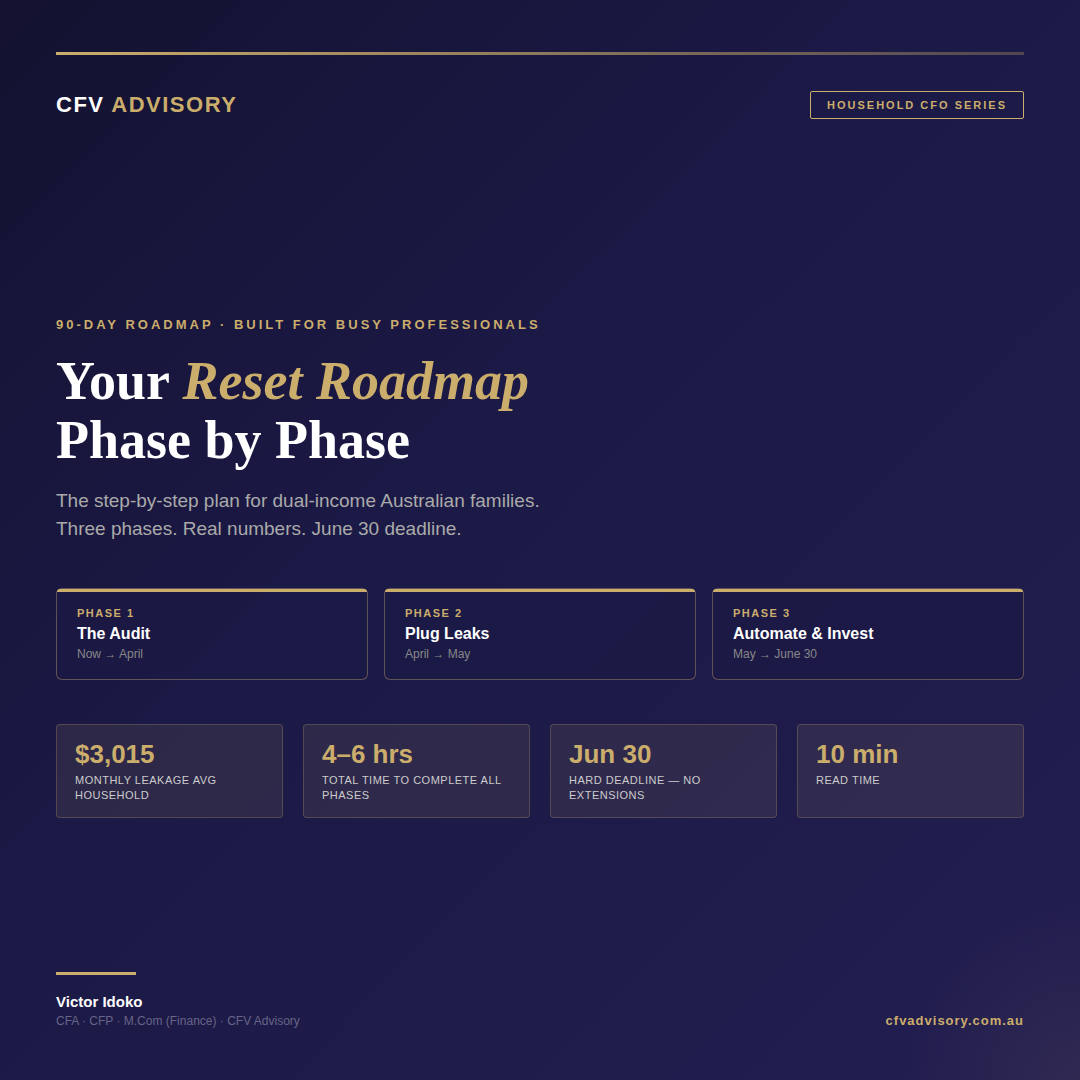
Your 90-day reset roadmap is not a budget overhaul. It’s a three-phase financial sprint designed specifically for busy Australian professionals — one that uses the EOFY window to recover real money, lock in lasting structures, and build momentum that continues long after June 30.
Momentum beats perfection. That’s the foundational principle behind the 90-day reset roadmap for dual-income Australian families. Annual financial planning tends to collapse under the weight of its own ambition — too many categories, too many decisions, too long a horizon. As a result, most couples declare good intentions at the start of a new year and quietly abandon them by February.
The 90-day roadmap works differently. Rather than attempting to fix everything at once, it operates in three focused phases — each one building directly on the last. Phase 1 creates the clarity that Phase 2 requires. Phase 2 recovers the resources that Phase 3 deploys. Together, they form a complete sequence that any dual-income household earning $200,000–$400,000 can execute before June 30.
Furthermore, this isn’t a framework built for ideal conditions. It’s designed for the reality of professional life in your 30s and 40s: two careers, school-age children, a mortgage, and a calendar that never quite has room. Each phase is structured to require one to two focused sessions — not a weekend retreat or a complete lifestyle overhaul.
“Momentum beats perfection. Three focused phases, executed in sequence, produce more lasting change than any annual plan ever drafted in optimism and abandoned by autumn.”
Your 90-Day Roadmap Overview
01 — Phase 1 in Detail: The Household Audit
The audit phase is about building an honest, complete picture of your household’s financial position. Most families have a rough sense of their income but a very blurry sense of their outgoings — and almost no clear picture of the gap between what they’re paying in tax, debt, and insurance and what they could be paying with better structures in place.
Specifically, Phase 1 focuses on four areas. First, your cash flow — the actual number that remains after all spending, debt service, and recurring commitments. Second, your tax position — not just your PAYG summary, but how your salary sacrifice usage, deduction claims, and super contribution levels compare to what the ATO’s rules permit. Third, your insurance portfolio — how much you’re paying, what you’re actually covered for, and where overlap or gaps exist. Fourth, your debt structure — interest costs, offset utilisation, and whether your current mortgage rate reflects the market.
The Audit Is Not a Judgment — It’s a Map
It’s worth noting that the audit process is not about assigning blame for past decisions. It’s about building the map you need to navigate the next 60 days. The families that benefit most from a thorough leakage audit are usually those who simply hadn’t stopped to look — not those who’d been reckless. In most cases, the leaks are entirely structural.
Additionally, the audit creates alignment between partners. For dual-income couples, financial decisions are often made in silos — each partner managing their own accounts while the household position remains unclear to both. Therefore, completing Phase 1 together is one of the most valuable outcomes of the entire reset process.
Your 90-Day Reset Roadmap: Phase 1 Audit Steps
02 — Phase 2 in Detail: Plug the Leaks
Phase 2 is where the audit becomes action. By this point, you have a clear picture of where money is leaking — and the goal is to address each category systematically before entering the EOFY window. In most cases, the total leakage across tax, debt, and insurance runs to approximately $3,015 per month for a $280,000-income household. Recovering even half of that is a material shift in the household’s financial trajectory.
Tax: The Highest-Value Lever
For dual-income earners, the tax leak is almost always the largest recoverable item. As a result, it deserves the most focused attention in Phase 2. The primary tool is salary sacrifice into superannuation — contributing pre-tax income to super reduces taxable income at the marginal rate, with contributions taxed at only 15% inside the fund. For a household earning $185,000 and $95,000, maximising both partners’ concessional contributions to the $30,000 cap can reduce the combined tax bill by $6,000–$10,000 annually.
Additionally, if either partner earns above $250,000, it’s important to review Division 293 tax — which applies an additional 15% levy on concessional contributions, bringing the effective tax rate inside super to 30%. In that scenario, the calculation changes and salary sacrifice may need to be recalibrated. Smart tax planning before June 30 should account for this nuance.
Debt: Structural Optimisation Before June
For most dual-income couples, the mortgage is the single largest balance on the household balance sheet — and also the asset most frequently left unoptimised. Specifically, two adjustments tend to produce outsized results. First, maximising the offset account balance. Every dollar sitting in offset reduces the interest calculation on the mortgage, effectively earning the mortgage rate (often 6.0–6.5%) tax-free. Second, renegotiating the rate if you haven’t done so in the past 12 months — for many borrowers, a direct conversation with their lender or a comparison via a broker yields 0.25–0.50% improvement, translating to several thousand dollars annually.
Turning your mortgage into a quiet wealth engine doesn’t require complex structures — it starts with ensuring your offset is working as hard as your salary.
Insurance: The Misunderstood Leak
Insurance is the least intuitive of the three leakage categories — because it’s not obviously wasteful. However, for many dual-income households, the insurance portfolio contains significant structural inefficiency: default super cover that isn’t fit-for-purpose, retail policies that haven’t been reviewed since they were originally purchased, and in some cases, multiple policies covering the same risk. Consequently, Phase 2 should include a line-by-line review of what each policy covers, what it costs, and whether the coverage level still reflects actual income and liabilities. The goal isn’t to cancel cover — it’s to ensure the premium is buying real protection, not just confidence.
Phase 2 Priority Order for Dual-Income Households
① Tax — salary sacrifice to cap, review deductions, check Division 293 if applicable
② Offset — max balance on payday, review rate competitiveness
③ Insurance — review all policies, remove overlap, confirm coverage is appropriate
④ Subscriptions & recurring costs — cancel anything not actively used; renegotiate anything that hasn’t been reviewed
03 — Phase 3 in Detail: Automate & Invest Before June 30
Phase 3 converts the work done in Phases 1 and 2 into durable, compounding structures. Specifically, there are two objectives in this phase: automate the improvements so they don’t require ongoing effort, and direct any recovered cash flow toward compounding assets before the financial year closes. Both must happen before June 30.
Why Automation Is Non-Negotiable
The most common failure mode after a financial reset is reversion. Structures that depend on manual action — reviewing, remembering, transferring — tend to break down within one to three months as work and life reclaim the space. Therefore, Phase 3 is about removing human intervention from the process. Salary sacrifice is set and reviewed annually. Offset transfers happen automatically on payday. Investment contributions run on a standing schedule. As a result, the household’s financial system functions in the background, regardless of how busy life becomes.
The EOFY Contribution Window
Crucially, the June 30 deadline is not flexible. Super contributions must be received by the fund — not merely initiated — before June 30 to count toward the current financial year’s concessional cap. For BPAY contributions, this typically means processing three to five business days before month end. For many dual-income couples, the $30,000 concessional contributions cap represents the single largest tax-reduction lever available — and leaving it unused is simply leaving money with the ATO.
Where to Direct the Freed-Up Surplus
Once leaks are plugged, the natural question becomes: where does the freed-up surplus go? For most dual-income households, there are three options — and the right priority order depends heavily on your life stage. The three options are: debt recycling (invest borrowed equity, convert home loan interest to deductible), the mortgage offset account (reduce non-deductible interest, tax-free return), and concessional super contributions (pre-tax, compound inside a 15% tax environment). Each of these is powerful. However, the order in which you prioritise them changes significantly depending on whether you’re in your 30s and 40s — or approaching retirement.
Option 1: Debt Recycling — The Tax Engine for Your 30s and 40s
Debt recycling is the process of converting non-deductible mortgage debt into deductible investment debt — effectively turning your home loan into a tax-effective wealth-building tool. Here’s how it works in practice: as you pay down your mortgage (or accumulate funds in your offset), you redraw that equity and invest it into income-producing assets — typically a share portfolio or managed fund. Because that borrowed money is now used for investment purposes, the interest on that portion of the loan becomes tax-deductible.
For a couple in their 30s or early 40s — with a mortgage, high marginal rates, and 20+ years before they can access super — debt recycling can create a significant tax advantage that compounds over time. Each year, the investment income and capital growth build outside super with full liquidity, while the interest deduction reduces taxable income at the marginal rate (often 39% or 47% including Medicare levy). Furthermore, as the investment portfolio grows, so does the deductible debt position, creating an accelerating tax benefit year after year.
Debt Recycling: A Practical Example
A couple with a $750,000 mortgage and $50,000 in offset. They redraw $50,000 and invest in a diversified share portfolio. The $50,000 portion of their loan interest — say $3,250/year at 6.5% — is now tax-deductible. At a marginal rate of 39%, that’s a $1,268 annual tax saving. They reinvest the refund. Next year, the investable base is larger — and so is the deduction. Over 10–15 years, this compounds into a material investment position built largely on what would otherwise have been non-deductible interest.
Importantly, debt recycling requires careful structuring. The loan split must be clearly documented, the investments must genuinely produce income, and the strategy must be set up correctly from the outset — otherwise the interest deductibility can be challenged by the ATO. Therefore, this is one area where working with an adviser before you start is strongly recommended. Turning your mortgage into a wealth engine starts with getting the structure right.
Option 2: The Mortgage Offset — Always the Foundation
The offset account is the starting point for all three options — not a lesser alternative. Before debt recycling can work, you need equity to redraw. Before super contributions compound, you need to eliminate the drag of high non-deductible interest. Consequently, the offset should always be fully funded on payday before any surplus is allocated elsewhere. Every dollar sitting in offset is earning the mortgage rate (currently 6.0–6.5%) on a tax-free, risk-free basis — a hard return to beat with any other conservative option.
Option 3: Concessional Super — Front and Centre as Retirement Approaches
Superannuation becomes the dominant strategy as you move through your 50s and approach retirement. By that stage, the mortgage is typically smaller or paid off, the investment portfolio outside super may already be established, and the preservation age for super access is within a clear timeframe. As a result, the calculus shifts: maximising concessional contributions to the $30,000 annual cap — and potentially using carry-forward provisions to top up prior years’ unused cap — delivers the most tax-efficient compounding of the available options.
Additionally, for those over 50 with balances below $500,000, the five-year carry-forward rule allows catch-up contributions that can substantially boost the super balance in the final accumulation years. This is particularly powerful for one partner who may have spent time out of the workforce — contributing in concentrated bursts before retirement can close a significant gap.
Offset — foundation always first
Debt recycling — tax engine
Super — employer + some sacrifice
Super — max concessional + carry-forward
Offset — reduce remaining mortgage
Debt recycling — wind down
The Bottom Line on Surplus Direction
For a couple in their 30s or 40s: prioritise debt recycling over maxing super. You have 20+ years before super access — outside-super investment via debt recycling builds a liquid, tax-advantaged portfolio you can access at any time, while also reducing your non-deductible mortgage faster.
For a couple in their 50s and beyond: shift the balance toward super. The concessional tax environment, carry-forward provisions, and decreasing time until access make maximising super contributions the dominant strategy. The exact tipping point depends on individual circumstances — which is exactly what personalised advice clarifies.
Phase 3 Automation Checklist — Before June 30
04 — What the 90-Day Reset Roadmap Actually Costs You
There’s a cost to doing the 90-day reset, and it’s worth naming directly. It costs approximately four to six hours across three months — roughly the equivalent of one quiet Sunday afternoon per phase. For most families, that’s the most significant barrier: not complexity, not money, but protected time to think about finances without interruption.
However, there’s also a cost to not doing it. For a household earning $280,000 with a $3,015 monthly leakage rate, inaction over the next 90 days costs approximately $9,000 in recoverable value — before compounding. Moreover, the tax savings missed before June 30 cannot be recovered after June 30. Unlike most financial decisions, the EOFY window has a hard close.
In other words, the question isn’t whether you have time. It’s whether you can afford the alternative. High income doesn’t automatically mean wealth — and the gap between the two is usually widest for people who never quite got around to building the system.
Return on Time: The 90-Day Reset ROI for a $280K Household
05 — When to Bring in Professional Guidance
The three-phase roadmap above is genuinely actionable for households willing to invest the time. However, there are two points where professional advice materially changes the outcome — and they’re worth naming directly.
The first is tax structuring. For dual-income earners with complex positions — equity compensation, investment properties, self-employed income, or Division 293 exposure — the interplay between salary sacrifice, personal deductible contributions, and the concessional cap produces outcomes that are non-trivial to calculate correctly. Getting this wrong costs real money. Getting it right requires more than a calculator.
The second is Phase 3 investment allocation. Where to direct surplus — super, offset, or outside super — depends on factors that are highly individual: your age, existing super balance, marginal tax rate, investment time horizon, and liquidity needs. Furthermore, the right answer changes as your income and liabilities change. A financial adviser doesn’t just answer the question once — they track it over time and adjust the allocation as your circumstances evolve.
Most importantly, the families that benefit most from professional guidance are not those in financial trouble. They’re households earning well, paying their bills, and quietly wondering why their wealth isn’t keeping pace with their income. That gap — between income and wealth — is exactly what the 90-day reset roadmap is designed to close. And it closes fastest with expert input.
About the Author
Victor Idoko, CFA · CFP · M.Com (Finance)
Victor is the founder of CFV Advisory and the author of 7 Basic Wealth Strategies. He works with dual-income Australian professionals to build household financial systems that generate real, lasting wealth. Victor’s approach combines technical rigour with practical clarity — because the best financial plan is one that actually gets implemented.
Ready to run your 90-day reset with expert guidance? Book a no-obligation introduction with Victor.
Start Your 90-Day Reset This Week
Victor works with dual-income Australian households to build financial systems that last beyond the 90 days. In one conversation, he’ll map your current position and show you exactly which levers to pull before June 30.
Book Your Introduction — No Obligation
No cost. No commitment. Just a clear plan before June 30.
General Advice Disclaimer: The information contained in this article is general in nature and does not take into account your personal objectives, financial situation, or needs. Before acting on any information, you should consider whether it is appropriate for your circumstances. CFV Advisory is an authorised representative of a licensed Australian financial services provider. Past performance is not a reliable indicator of future performance.