
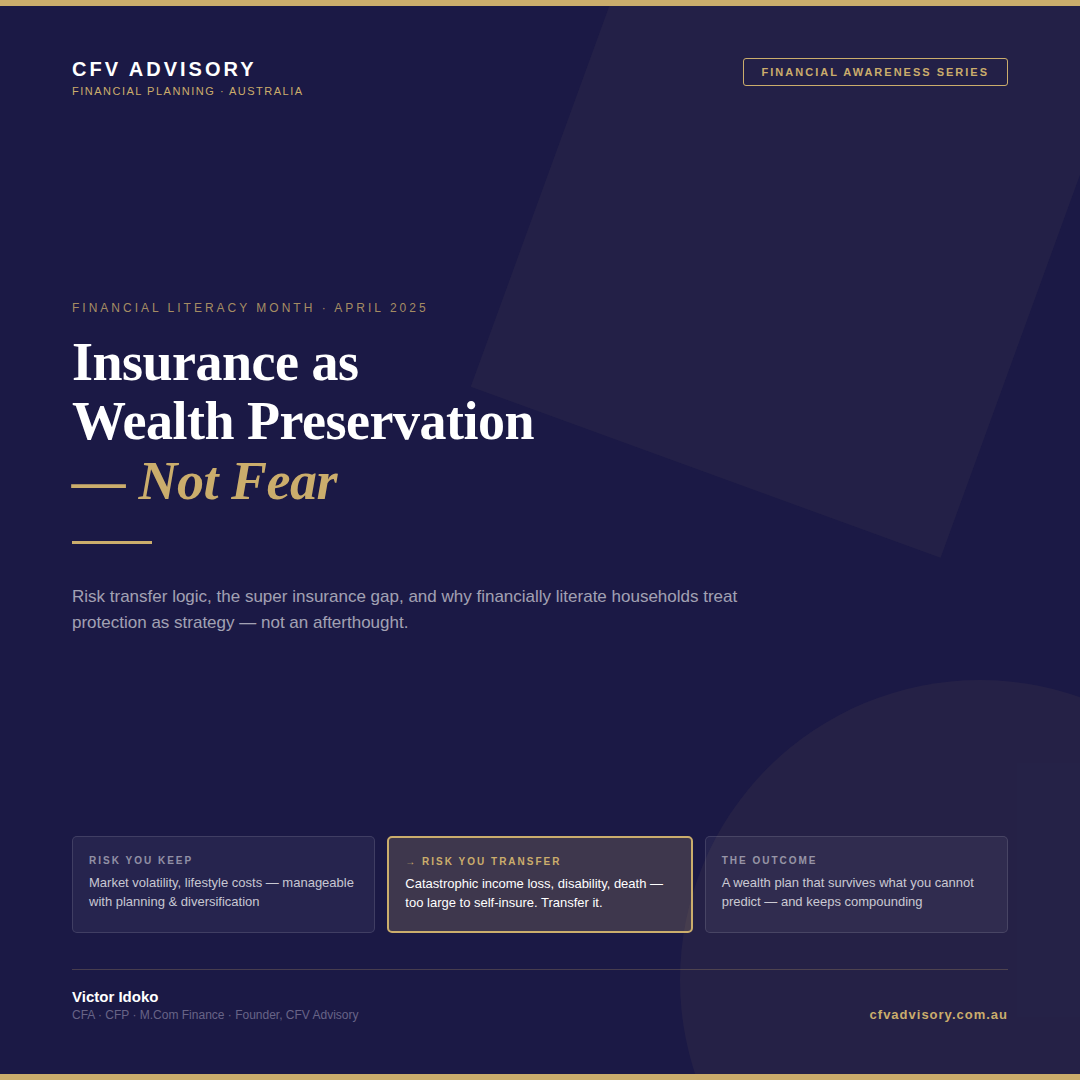
Insurance as wealth preservation means understanding one thing clearly: you are not buying protection against fear — you are transferring financial risk away from your household, permanently, so that your wealth-building plan survives whatever life throws at it.
Financial literacy — real financial literacy — is not knowing what a P/E ratio means or how to read a superannuation statement. It is understanding the mechanics of risk in your own household. It is knowing which risks you can absorb, which ones you can mitigate with behaviour, and crucially, which ones are so large and so unpredictable that the only rational response is to transfer them to someone else entirely. That is what insurance does. That is the logic that sits behind every well-structured protection strategy — and that most dual-income Australians have never had explained to them clearly.
The data from the Adviser Ratings 2025 report makes this gap tangible. Surveying Australians’ primary concerns around wealth transfer and financial planning, the research found that 63% cited solutions for tax minimisation as a top priority — yet protecting the underlying income that makes tax minimisation possible barely registered. The irony is significant: households spend considerable energy optimising the yield from a wealth-building programme that could be dismantled overnight by an uninsured health event.
This article is about reframing insurance entirely. Not as a product to be sold. Not as a fear-based response to mortality. But as a rational, evidence-based, wealth-preserving mechanism that every professional household should be constructing deliberately — and reviewing annually.
“Financial literacy is understanding what actually protects your lifestyle — not just your assets. Risk transfer is one of the most powerful tools in a professional household’s wealth toolkit. Most Australians never learn it.”
— Victor Idoko, CFA · CFP · M.Com Finance | CFV Advisory
THE RISK TRANSFER FRAMEWORK
How Strategically Structured Insurance Fits Into a Wealth Plan
Risk You Keep
Day-to-day expenses, market volatility, career setbacks, lifestyle fluctuations. These you manage with cash reserves, diversification, and financial planning.
Risk You Transfer
Catastrophic income loss, death, permanent disability, long-term illness. These are too large and unpredictable to self-insure. Transfer them. Completely.
The Result
A wealth plan that is genuinely resilient — not just optimised for the best case. The difference between building wealth and keeping it.
The Logic of Risk Transfer: Why Insurance Is a Financial Decision, Not an Emotional One
Risk transfer is an economic concept as old as commerce itself. The principle is straightforward: when a risk is too large to absorb individually, you pay a premium to distribute it across a pool of participants. The insurer takes on the risk; you receive certainty. This is not pessimism. It is rational economics applied to your personal balance sheet.
For a professional household, the risks that warrant transfer are those that are both severe and beyond your ability to predict or absorb. A market correction that reduces your portfolio by 20% is a risk you can absorb — time, diversification, and income enable recovery. However, the permanent loss of your earning capacity — due to a serious illness, a debilitating injury, or an early death — is not a risk you can absorb. The numbers simply don’t work. Consequently, the only rational response is to transfer it.
Consider this framing: you would not self-insure your $1.2 million home. The potential loss is too large and too unpredictable. Therefore, you insure it — not because you expect it to burn down, but because the cost of being wrong is catastrophic. Your income, your health, and your life are substantially more valuable than your home — and yet most dual-income households insure their property comprehensively while leaving their most valuable assets underprotected or unprotected entirely.
Furthermore, risk transfer through insurance does something that no other financial tool can: it removes the uncertainty itself. Once a risk is genuinely transferred, it stops being a variable in your financial planning. You don’t need to hold excess cash reserves against it. You don’t need to take lower investment risk because of it. In effect, proper insurance enables better financial decision-making across your entire wealth strategy — because it eliminates the biggest unknown from the equation.
📈 RISK TRANSFER LOGIC
You insure your $1.2M home without hesitation. A 38-year-old professional has $4.86M+ in future earnings on the table. The economics of insuring your income are identical — the scale is simply larger, and the consequences of not doing it far more severe.
Why Super-Linked Insurance Is Almost Always Insufficient
The single most common source of false confidence in the Australian protection landscape is the assumption that super-linked insurance provides adequate cover. It almost never does — and for professional households specifically, the gap between what super provides and what they actually need is often measured in hundreds of thousands of dollars.
Super funds provide default life, TPD, and sometimes income protection cover — but the mechanics are designed for simplicity and cost efficiency across a broad membership base, not for the specific risk profile of a 41-year-old with a $950,000 mortgage, a $280,000 household income, and two dependent children. As a result, default cover is typically expressed in units (e.g., $100,000 life cover per unit), with the number of units rarely reviewed after the initial onboarding. Moreover, as super funds have progressively reduced default cover levels to protect member balances from excessive premium erosion, the problem has compounded.
There is also a structural problem with super-linked TPD cover specifically. Most super funds define TPD as the inability to perform any occupation — a far more restrictive definition than the own occupation definition available through individually underwritten policies. Under an “any occupation” definition, a surgeon who loses the use of their hands may still be deemed capable of working as a medical consultant — and therefore not eligible to claim. Under an “own occupation” definition, the same event triggers a valid claim. For professionals whose earning capacity is tied to a specific skill set, this distinction is not academic. It is potentially career-defining and financially catastrophic.
Additionally, super-linked income protection — where it exists at all — is frequently limited to a two-year benefit period. For a 35-year-old with a long-term disability, a two-year payment period covers a fraction of the income replacement they genuinely require. In contrast, individually structured income protection policies can pay to age 65, providing coverage across the full working life. The premium difference between these two structures is meaningful. However, the protection gap is far larger.
⚠ CRITICAL DISTINCTION
Super TPD uses “any occupation” definition by default. Standalone TPD uses “own occupation.” For a specialist professional, this is the difference between a valid claim and a denied claim for the exact same disabling event. Always check the definition before assuming you’re covered.
What Financial Literacy Around Insurance Actually Looks Like
True financial literacy around insurance is not knowing what the premiums cost. It is understanding what you are buying, why it is priced as it is, and how it integrates with your broader financial position. Additionally, it means asking the right questions — and recognising when you are not getting clear answers.
The first principle of insurance literacy is understanding the difference between a premium and a cost. A premium is a known, planned expense. A cost is what you pay when the risk materialises and you have no cover. The two are not equivalent. For a $280,000 household, an income protection premium of $3,500–$5,000 per year is a known, manageable, tax-deductible figure. The alternative — an uninsured income disruption — could cost $140,000 in year one alone, and compound from there.
The second principle is understanding policy structure. Not all income protection policies are equivalent. As noted, waiting periods, benefit periods, and definitions of disability vary enormously and are consequential. Moreover, step premiums (which increase with age) versus level premiums (which are fixed at policy inception) create very different long-term cost profiles. For a 35-year-old with a 30-year horizon, a level premium structure is often significantly more cost-effective over the life of the policy — but requires a larger initial outlay that most policyholders are not briefed on properly.
The third principle — and the one that separates financially literate households from those simply reacting to their situation — is proactive review. Insurance needs do not stay static. They evolve with income, debt levels, family structure, and asset base. Specifically, as household wealth grows, the required quantum of cover changes. A household with $1.2 million in liquid investment assets needs less life insurance to achieve the same outcome as a household with $200,000. The right cover level at age 35 may be too high by 45 and dangerously low if the household’s financial position has changed significantly.
📚 INSURANCE LITERACY CHECKLIST
Do you know your current cover levels across income protection, life, and TPD—and the definition of disability in your TPD policy? More importantly, do you know whether your income protection has a two-year or to-age-65 benefit period? If you answered “no” to any of these — you have a gap, and it may be costing you far more than the premium to fix it.
The Adviser Ratings Data: What Australians Actually Want from Wealth Protection
The Adviser Ratings 2025 research provides a compelling snapshot of where Australian households believe their wealth vulnerabilities lie — and what they want from their advisers in response. The data reveals some instructive patterns for understanding the current state of insurance literacy in this country.
When asked what concerns them most regarding wealth transfer, 63% of respondents cited tax minimisation solutions as a primary concern. Additionally, 54% flagged preserving family wealth across generations, and 47% wanted guidance on when to distribute wealth. These are meaningful, sophisticated concerns — they reflect the aspirations of households that have built wealth and now want to know how to keep it and pass it on.
However, the research also reveals what advisers actually prioritise when managing intergenerational wealth. Developing comprehensive estate plans was the top strategy at 53%, followed by advising on tax-efficient gifting at 47%, and providing family governance and wealth education at 45%. Setting up and managing trusts — a core tool in multi-generational wealth preservation — was employed by 28% of advisers. As a result, we see a clear alignment: clients want to protect and transfer their wealth, and advisers are deploying the estate planning and tax tools to help them do it.
What sits beneath all of this — and what the data does not explicitly capture — is the foundational layer that makes every one of these strategies possible: protecting the income and life of the person generating the wealth in the first place. Estate planning is irrelevant without an estate. Tax-efficient gifting is academic if the wealth pool was depleted by an uninsured income disruption. In other words, wealth protection strategy and insurance strategy are the same conversation — and they need to be treated as such.
📊 ADVISER RATINGS 2025
63% of Australians want tax minimisation solutions. 54% want to preserve family wealth across generations. But without adequate income protection, life cover, and TPD — the foundation those aspirations rest on is exposed. Estate planning protects what you’ve accumulated. Insurance protects your ability to keep accumulating it.
Building a Protection Architecture That Matches Your Wealth Plan
The concept of a “protection architecture” is useful precisely because it frames insurance as a designed system, not a collection of ad hoc policies. In the same way that a sound investment portfolio is constructed with purpose, balance, and an eye on the long term — a protection strategy should be built with the same deliberateness.
At the base of the architecture sits income protection — the policy that maintains cash flow in the event of illness or injury. Without this, every other element of the financial plan becomes fragile. Consequently, income protection is never optional for a household that has financial obligations and dependants. Above that sits life cover — sized, as previously noted, to clear debts, replace income for the surviving partner, and fund the future costs of dependants. This should be reviewed at every major life milestone: property purchase, new dependant, income increase, or significant change in net worth.
TPD cover completes the protection layer — and given the cost of a long-term disability event, it deserves more weight than it typically receives. For professional households, own-occupation TPD is non-negotiable. Moreover, the quantum should be sized to fund genuine lifestyle continuation, not just debt clearance. Critical illness (trauma) cover is also worth considering for households with aggressive financial plans — it provides a lump sum on diagnosis of specified conditions (heart attack, stroke, cancer), enabling treatment without financial derailment.
Finally, the architecture must account for holding structures. Holding income protection outside super preserves the tax deductibility of premiums. Holding life and TPD inside super can be tax-effective for premium funding — but introduces a two-step claim process that can create delays. Additionally, the lump sum paid inside super may have tax implications depending on the beneficiary and the components of the super balance. Therefore, the decision of where to hold each cover type should be made in the context of your specific tax position and estate plan — not as a default. For more on how protection integrates with a broader wealth architecture, see our article on building long-term financial infrastructure.
🏛 THE PROTECTION ARCHITECTURE
Base: Income protection (to-age-65 benefit, own occupation, held outside super for tax deductibility). Middle: Life cover (debts + income replacement + dependant costs). Top: Own-occupation TPD (10–15x income net of assets) + trauma cover. Structure: Income protection outside super; life/TPD inside super reviewed against estate plan and tax position.
Super-Linked vs Standalone Insurance: Key Differences for Professional Households
Feature
Super-Linked (Default)
Standalone / Individually Underwritten
TPD Definition
Any occupation — must be unable to work in any role for which qualified
Own occupation — unable to perform your specific role
Income Protection Benefit Period
Typically 2 years maximum
To age 65 available — covers full working life
Cover Quantum
Unit-based default — generic, rarely reviewed, typically covers <20% of actual need
Tailored to income, debts, dependants, and financial plan
Tax Deductibility (Income Protection)
Premiums paid from concessional super — no additional personal tax deduction
Premiums held outside super are tax-deductible — up to 47% government co-funding
Premium Structure
Step premiums only — rising cost every year
Level or step premiums available — level locks in cost at policy inception
The Most Important Financial Literacy Habit You Can Build Right Now
If Financial Literacy Month prompts one action in your household, make it this: schedule a protection review. Not a product review. A protection review — one that starts with your actual financial position, your dependants, your debts, your investment trajectory, and your risk exposure — and builds backward to the cover you genuinely need.
As a starting point, review the ATO’s guidance on super-linked insurance and Division 293 implications for higher-income earners. Additionally, understand your concessional contributions cap and how insurance premiums paid inside super affect your available cap. These are the mechanics that most households are unaware of — and that create meaningful differences in tax efficiency over time.
Moreover, understand that financial leakage in a dual-income household is not always visible in the budget. Sometimes it is the insurance cover that is simultaneously over-priced and under-effective — paying too much for policies that don’t actually protect what you need to protect. A proper review surfaces both problems.
Wealth preservation is not a passive activity. It requires deliberate choices about which risks you carry and which you transfer. The households that build durable, generational wealth in Australia are not necessarily the ones that invest the most aggressively. They are the ones that take risk management as seriously as return generation — because they understand that protecting what you have is just as important as building more of it.
About the Author
Victor Idoko CFA · CFP · M.Com Finance
Victor is the founder of CFV Advisory and author of 7 Basic Wealth Strategies. He works with dual-income professional households across Australia on protection strategy, tax-effective investing, and long-term wealth architecture. Victor’s approach treats insurance not as a product sale but as a foundational element of any serious wealth plan — one that is built deliberately, reviewed regularly, and integrated with everything else.
YOUR WEALTH PROTECTION REVIEW
Do You Know What Your Insurance Actually Covers?
Most dual-income households are significantly underinsured — not because they can’t afford it, but because no one has ever sat down with them and worked through what they actually need. In one focused conversation, we can review your protection architecture, identify genuine gaps, and build a strategy that is sized to your financial plan — not a generic benchmark.
Book Your Complimentary Introduction
No obligation. No product push. Just a clear picture of where your protection actually stands.
General Advice Disclaimer: The information in this article is general in nature and does not constitute personal financial advice. It has been prepared without taking into account your individual objectives, financial situation, or needs. Before acting on any information, you should consider its appropriateness to your circumstances and seek advice from a licensed financial adviser. Victor Idoko (AR No. [insert]) is an Authorised Representative of [AFSL holder]. CFV Advisory is a registered business operating under Australian financial services laws. Insurance definitions, benefit periods, and policy structures vary between providers — always obtain a Statement of Advice and review a Product Disclosure Statement before making any insurance decision.