
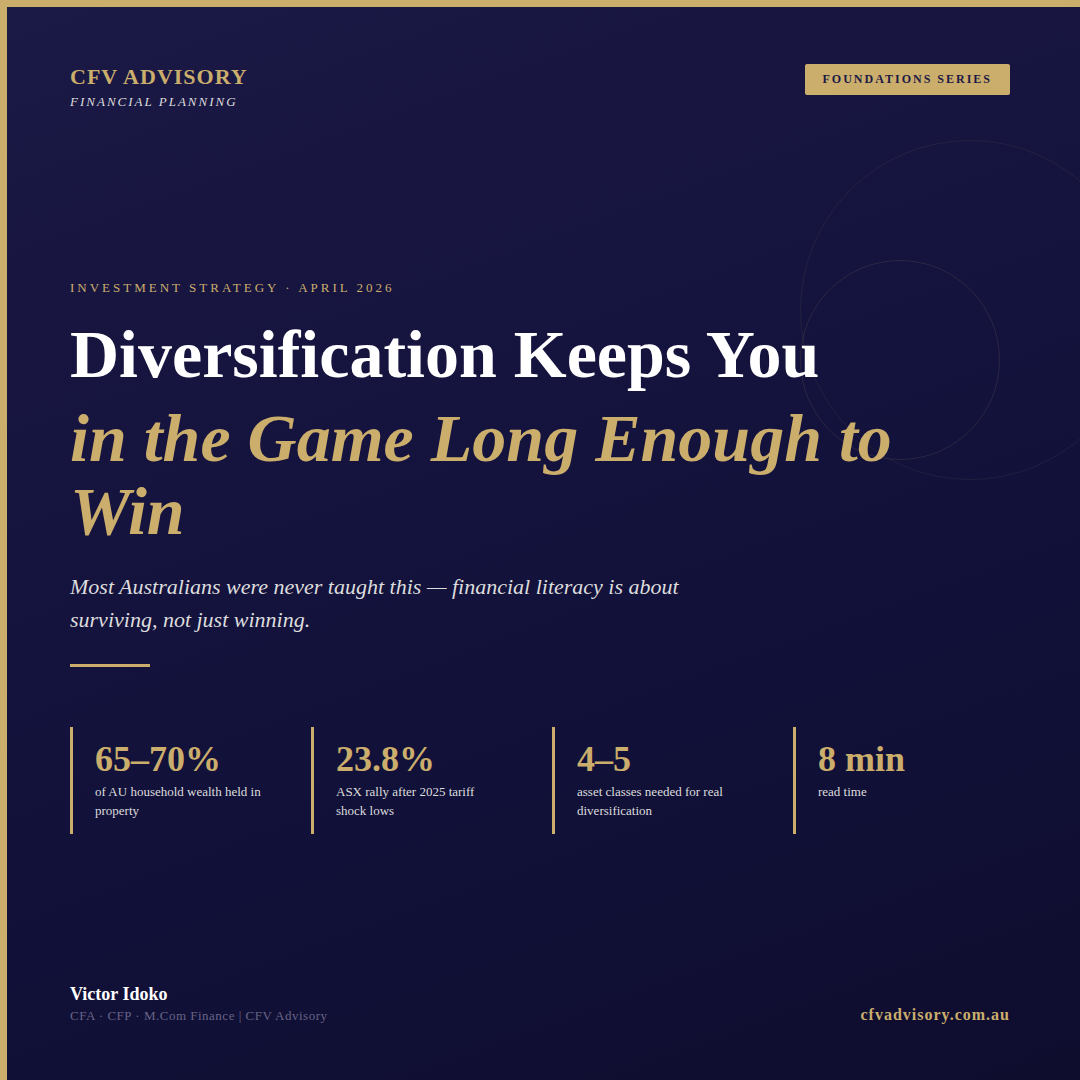
Investment diversification in Australia isn’t about finding the best-performing asset. It’s about staying in the game long enough for compounding to do its work — because the investors who got wiped out never got to see the recovery.
In April 2025, the ASX fell 14.2% in a matter of weeks. Tariff announcements from the United States triggered one of the sharpest corrections in years. Markets panicked. Commentators predicted disaster. Then, by October 2025, the ASX had rallied 23.8% from those lows — hitting an all-time high of 9,094 in late October. The investors who captured that recovery weren’t the smartest in the room. They were simply the ones who hadn’t already sold.
That pattern — shock, panic, recovery — has repeated itself through the GFC, the COVID crash, the 2025 tariff shock, and Q1 2026’s oil-driven volatility when geopolitical tensions in the Middle East sent crude oil up roughly 50% in three months. Each time, the investors who survived the downturns and stayed diversified were the ones who built genuine long-term wealth. This article is about why investment diversification in Australia isn’t optional — and what it actually looks like for dual-income families earning $200K to $400K.
“You don’t need to pick the winning asset. You need to avoid being wiped out by the losing one.”
Victor Idoko, CFA · CFP · CFV Advisory
What This Article Covers
Why Surviving Is the Real Strategy
65–70%
of AU household wealth held in property
23.8%
ASX rally from 2025 tariff shock lows
4–5
asset classes needed for genuine diversification
54%
of Australians concerned about preserving family wealth across generations
Section 01
The Australian Concentration Problem
Australian households carry one of the most concentrated investment positions of any developed nation. Between 65 and 70 cents in every dollar of household wealth sits in residential property — usually the family home and, for many, a single investment property in the same city. Add the mortgage on both, and you have a portfolio that is leveraged, illiquid, and almost entirely exposed to one asset class in one geography.
This isn’t a criticism of property. Australian property has delivered solid long-term returns, and for many families it remains the foundation of their wealth. However, the problem isn’t owning property — the problem is owning only property, or holding it so disproportionately that every other financial decision is made around its limitations. Furthermore, as Adviser Ratings data shows, 54% of Australians are worried about preserving family wealth across generations. Concentration is the single greatest threat to that goal.
The Concentration Test
Ask yourself: if Australian property prices fell 20% tomorrow and the ASX also fell 15% — what would your net worth look like? If the answer makes you uncomfortable, that’s not a market problem. That’s a diversification problem. For most dual-income couples, investment diversification in Australia needs to start with an honest answer to this question.
The issue is structural rather than behavioural. Australian culture has, for decades, treated property as the default wealth-building vehicle. Negative gearing, capital gains tax discounts, and the cultural prestige of property ownership have all reinforced this belief. As a result, many high-income couples in the $200K to $400K range reach their late 30s with substantial equity in their home, strong super balances they largely ignore, and little else. That’s not a wealth portfolio — it’s a concentrated bet.
Section 02
Shocks Are Inevitable — What History Shows
The most important thing to understand about market shocks is that they are not exceptional events — they are routine features of the investment landscape. Consequently, the question isn’t whether a shock will hit your portfolio. The question is whether your portfolio is structured to survive it.
Consider the record in Australia alone. The GFC saw the ASX fall more than 50% over 18 months. The COVID crash in March 2020 saw it drop 37% in five weeks. The April 2025 tariff shock triggered a 14.2% fall from the February high. In Q1 2026, a geopolitical escalation in the Middle East sent oil prices up roughly 50%, reigniting inflation, resetting RBA rate-cut expectations, and sending equity markets into another period of sharp volatility. Each of these events felt, in the moment, like something different. In hindsight, they were all versions of the same story — temporary disruption followed by recovery. Moreover, every recovery rewarded the investors who stayed diversified and stayed in the game.
What Diversification Did During These Events
During the April 2025 tariff shock, Australian shares fell sharply. However, investors with international equity exposure benefited as different markets moved at different speeds. Bonds rose in value as investors sought safety. Defensive equities — utilities, consumer staples, healthcare — held significantly better than cyclicals. Cash in an offset account meant no margin calls, no forced selling, and the liquidity to keep contributing. That’s investment diversification in Australia working exactly as it should.
Similarly, during Q1 2026’s oil-driven volatility, energy stocks gained while growth equities fell. Bonds provided stability relative to longer-duration assets. Gold stalled but held. A portfolio concentrated entirely in Australian growth shares felt every point of that decline. A diversified portfolio absorbed most of the shock and required no dramatic action. In short, diversification is not about maximising returns in calm markets — it’s about managing the damage in turbulent ones.
The Recovery Maths
If your portfolio falls 50%, you need a 100% gain just to get back to even. If it falls 20%, you only need 25%. Therefore, every percentage point of loss you avoid isn’t just about protection — it dramatically reduces the return required to recover. This is why avoiding the blow-up is more important than chasing the gain.
Section 03
What Investment Diversification in Australia Actually Looks Like
Genuine diversification isn’t just owning a few different shares alongside your investment property. It’s exposure across asset classes that behave differently — that genuinely zig when others zag. For Australian investors, that means building across at least four to five distinct categories.
A Diversified Portfolio — Australian Context
Equally important is diversification within asset classes. For example, owning Australian shares shouldn’t mean owning only bank stocks — even though the big four dominate the ASX. Similarly, owning property shouldn’t mean owning only in one suburb. Geographic and sector diversification within each asset class matters as much as diversification across them. You can read more about this in our article on using home equity to invest, which covers how to expand beyond property without abandoning it.
Section 04
Super Is Your Silent Diversifier — And Most Couples Under-Use It
For dual-income couples earning $280,000 combined, superannuation is almost certainly their second-largest asset — and almost certainly the one they think about least. A couple in their mid-to-late 30s might have $200,000 to $350,000 combined in super, spread across balanced funds that already hold Australian shares, international shares, property trusts, infrastructure, bonds, and cash. In other words, super is already a diversified portfolio. The challenge is that most couples are adding nothing beyond the mandated employer contributions.
Moreover, salary sacrificing into superannuation — up to the $30,000 annual concessional contributions cap — is one of the most tax-effective ways to build a diversified portfolio. For a couple earning $180,000 and $100,000 respectively, the difference between the 47% marginal tax rate on income earned above the threshold and the 15% contributions tax inside super is enormous. That tax saving compounds over time in a diversified fund. As a result, many couples who feel like they’re not progressing on investments are actually sitting on an underutilised diversification engine.
ATO Reference
The ATO’s salary sacrificing page outlines how concessional contributions reduce taxable income while building your super balance. The concessional contributions cap is $30,000 per person from July 2024 — see the ATO’s full breakdown.
Note that for high-income earners above $250,000 in combined personal income, Division 293 tax applies — an additional 15% on concessional super contributions. Even so, the effective tax rate inside super remains lower than the top marginal rate. Therefore, salary sacrifice still improves both tax outcomes and portfolio diversification for most couples in the $200K–$400K range. The ATO’s Division 293 guidance covers the thresholds in full.
Section 05
The Survival Equation: What “Staying in the Game” Actually Means
The phrase “staying in the game” sounds passive. In practice, it requires deliberate structural decisions. First, it means having liquidity — specifically, an offset account and emergency fund that mean you never have to sell an investment at the wrong time because you need cash. Second, it means having no single asset that, if it fell significantly, would threaten your financial stability. Third, it means contributing regularly regardless of market conditions — dollar-cost averaging is one of the most underrated survival tools available.
A Benchmark Household: $280,000 Combined Income
Consider a couple earning $280,000 combined. They own their home with $400,000 in equity, hold $280,000 in combined super, and have $60,000 in a joint brokerage account invested in three Australian bank shares. Their offset account holds $45,000. On paper, their net wealth is approaching $750,000. However, on closer inspection, that portfolio is fundamentally undiversified: 53% in property, 37% in super (which they’re not actively growing), and 8% in three shares in the same sector. That’s not a wealth plan — that’s concentration risk wearing a prosperity mask.
Additionally, consider what happens if Australian bank shares fall 30% (as they have before), property prices correct 15%, and the couple needs to access cash for an emergency. Suddenly the offset is depleted, selling investments at a loss is the only option, and compounding has been interrupted precisely when it matters most. In contrast, a genuinely diversified version of the same portfolio — with spread across Australian shares, international equities, their super, their property equity, and a cash buffer — would absorb each of those individual shocks without catastrophic effect. The four leaks draining dual-income families often include the hidden cost of concentration — money that simply never gets the chance to compound because a single event forced a sale at the wrong time.
Long-Term Return Benchmarks — Australian Context
Indicative long-term averages. Past performance is not a reliable indicator of future performance. Always seek personal financial advice.
In practice, none of these assets delivers precisely these numbers in any given year. However, as a result of holding all of them, a diversified investor captures the average across the cycle — and crucially, avoids being entirely dependent on any single one performing well. The maths of compounding over a 10-year horizon makes this point powerfully: the difference between 7% and 9% per annum over a decade on $500,000 is $134,000. Staying in the game doesn’t just protect you — it pays you.
Investment Diversification in Australia: The Action That Matters
The complexity here isn’t the maths — it’s the implementation. Knowing you should be more diversified and knowing how to restructure your specific position across property, shares, super, and cash — while managing tax, mortgage, and cash flow — are different problems. For most high-income couples, the gap isn’t knowledge. It’s the tailored plan that connects the knowledge to their actual numbers.
Furthermore, diversification isn’t a one-time event. It requires reviewing your asset allocation as your income grows, your mortgage reduces, your super builds, and markets move. A portfolio that was appropriately diversified three years ago may be significantly concentrated today simply because property has grown faster than everything else. That’s not failure — it’s drift. And it’s entirely fixable with the right structure.
If you’d like to understand what a genuinely diversified position looks like for your specific household — across your income, your property equity, your super balance, and your surplus cash flow — we’d welcome a conversation. It’s a 45-minute call, no obligation, and no jargon. For many couples, it’s the most valuable financial conversation they’ve had. You can read more about finding the money already in your household to start building that diversified position.
About the Author
Victor Idoko
CFA · CFP · M.Com (Finance) | Founder, CFV Advisory
Victor Idoko is the founder of CFV Advisory and author of 7 Basic Wealth Strategies. He works with dual-income professional couples across Australia, helping them move from income to genuine long-term wealth through structured, personalised financial planning. Victor holds the Chartered Financial Analyst (CFA) and Certified Financial Planner (CFP) designations alongside a Master of Commerce in Finance.
Ready to Diversify?
Find Out What Your Portfolio Is Missing
In 45 minutes, we’ll map your current asset allocation, identify concentration risk, and outline what a genuinely diversified position looks like for your household. No jargon. No obligation. Just clarity.
No cost. No commitment. Available Australia-wide via video.
General Advice Warning: This article contains general information only and does not constitute personal financial advice. The information has been prepared without taking into account your personal objectives, financial situation, or needs. Before acting on any information in this article, you should consider its appropriateness to your circumstances and seek advice from a licensed financial adviser. Victor Idoko is an Authorised Representative of a licensed Australian Financial Services Licensee. Past performance is not a reliable indicator of future performance.